
Thymosin Alpha-1 Explained: Immune Modulation, T-Cell Signaling, and How It Works
Immune Modulation, T-Cell Signaling, and Host Defense Biology

Thymosin Alpha-1 is often described as an “immune boosting peptide.”
Thymosin Alpha-1 (Tα1) does not simply increase immune activity. It modulates immune signaling, particularly within T-cell function, antigen presentation, and cytokine regulation.
Unlike Thymosin Beta-4, which operates through cytoskeletal and tissue repair pathways, Thymosin Alpha-1 acts within the immune system, influencing how immune responses are initiated and regulated.
Understanding Thymosin Alpha-1 requires examining immune signaling dynamics rather than viewing it as a general stimulant.
This issue explains what Thymosin Alpha-1 is, how it works mechanistically, how it differs from Thymosin Beta-4, and what the research demonstrates.
What Is Thymosin Alpha-1?
Thymosin Alpha-1 is a 28–amino acid peptide derived from prothymosin alpha.
It is naturally present in the thymus and plays a role in immune system development and function.
Tα1 has been studied in contexts such as:
Viral infections
Immune dysfunction
Cancer-related immune response
Vaccine response enhancement
Unlike intracellular peptides such as Tβ4, Thymosin Alpha-1 acts through cell surface receptors and immune signaling pathways.
How Thymosin Alpha-1 Works (Mechanism of Action)
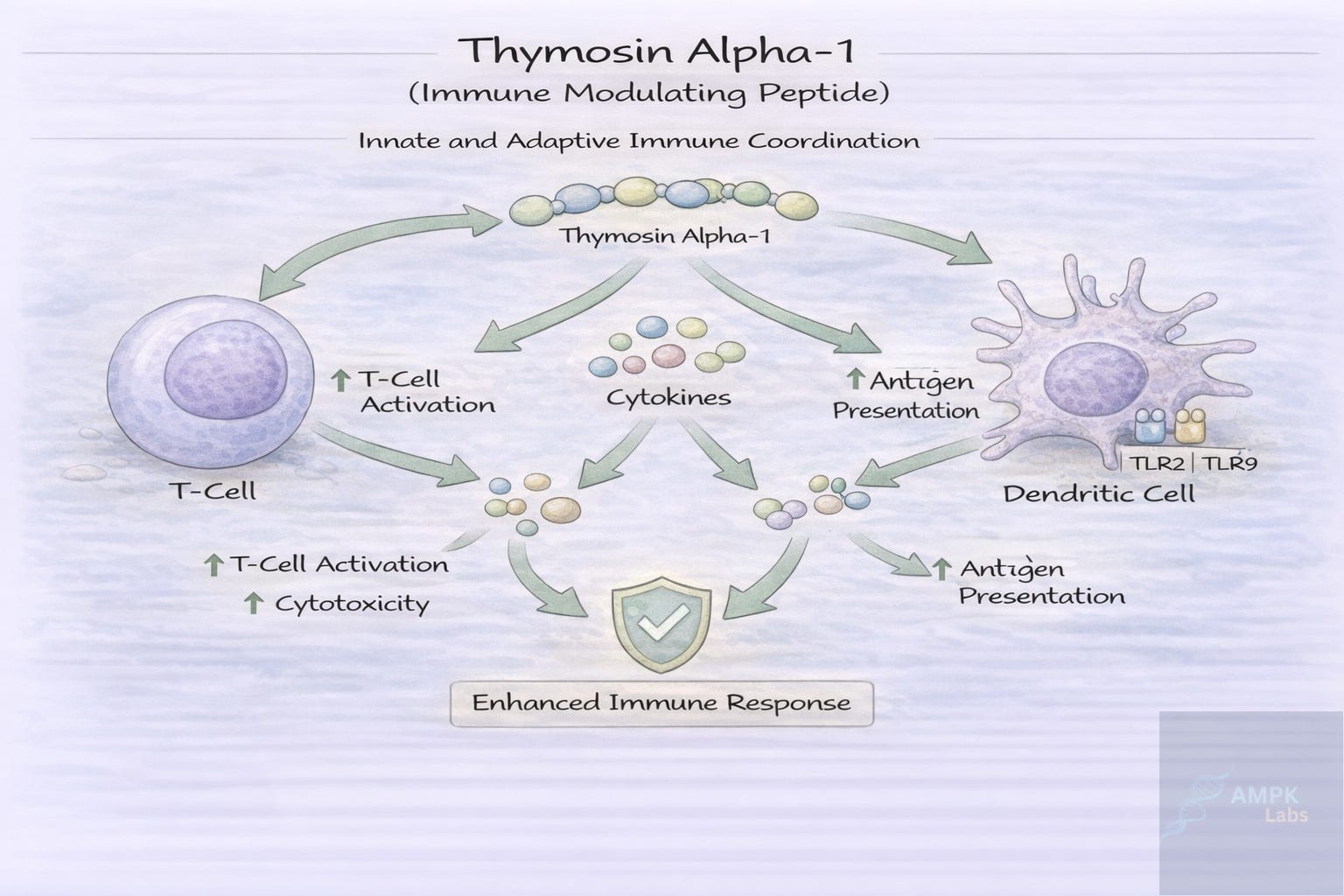
Thymosin Alpha-1 influences immune signaling across multiple pathways.
1. T-Cell Differentiation and Activation
Tα1 has been shown to influence:
T-cell maturation
T-cell differentiation
Immune response coordination
This is central to adaptive immunity.
2. Toll-Like Receptor (TLR) Signaling
Tα1 interacts with Toll-like receptors, particularly:
TLR2
TLR9
This influences innate immune activation and antigen presentation.
3. Cytokine Modulation
Tα1 has been associated with regulation of:
Interleukins
Interferons
Inflammatory signaling pathways
Rather than simply increasing inflammation, it appears to modulate immune balance.
4. Dendritic Cell and Antigen Presentation Effects
Tα1 enhances the ability of immune cells to:
Recognize pathogens
Present antigens
Coordinate immune responses
Educational Mechanism Diagram
Thymosin Alpha-1 vs Thymosin Beta-4 vs TB-500
Thymosin Alpha-1
- Immune signaling peptide
- Acts on T-cells and innate immune pathways
- Regulates cytokine signaling
Thymosin Beta-4
- Actin-binding intracellular peptide
- Controls cell migration and tissue repair
TB-500
- Synthetic fragment of Tβ4
- Used as a research analog
These peptides are frequently confused but operate in entirely different biological systems.
What the Research Shows
Preclinical Evidence
Tα1 has been shown to:
Enhance T-cell function
Improve immune response to infection
Modulate cytokine signaling
Improve antigen presentation
Human Evidence
Thymosin Alpha-1 has been studied in:
Chronic viral infections
Cancer immunotherapy support
Sepsis and immune dysfunction
Vaccine response enhancement
Outcomes measured include immune markers and clinical endpoints depending on the study context.
Common Public Claims and How They Compare to Evidence
“Thymosin Alpha-1 boosts immunity”
Tα1 influences immune signaling pathways, particularly T-cell activity.
It does not function as a non-specific immune stimulant.
“It increases inflammation”
Tα1 modulates immune responses and can influence both pro- and anti-inflammatory pathways depending on context.
“It is similar to Thymosin Beta-4”
These peptides belong to entirely different biological systems.
Key Takeaways
Thymosin Alpha-1 is an immune-modulating peptide
It influences T-cell and innate immune signaling
It acts through receptor-mediated pathways
It differs fundamentally from Thymosin Beta-4 and TB-500
It plays a role in immune regulation rather than tissue repair
Sources (audited title-to-link match)
Garaci E, Pica F, Serafino A, et al.
Thymosin alpha-1 and the immune system.
Annals of the New York Academy of Sciences.
https://pmc.ncbi.nlm.nih.gov/articles/PMC6741600/Romani L, Bistoni F, Perruccio K, et al.
Thymosin alpha-1 activates dendritic cells for antifungal Th1 resistance through Toll-like receptor signaling.
https://pubmed.ncbi.nlm.nih.gov/14982877/King R, Tuthill C.
Immune modulation with thymosin alpha 1.
Annals of the New York Academy of Sciences.
Immune modulation with thymosin alpha 1 PDF