
SS-31 Explained: Mitochondrial Protection, Cardiolipin Binding, and Cellular Energy
Mitochondrial Targeting, Cardiolipin Binding, and Bioenergetic Resilience

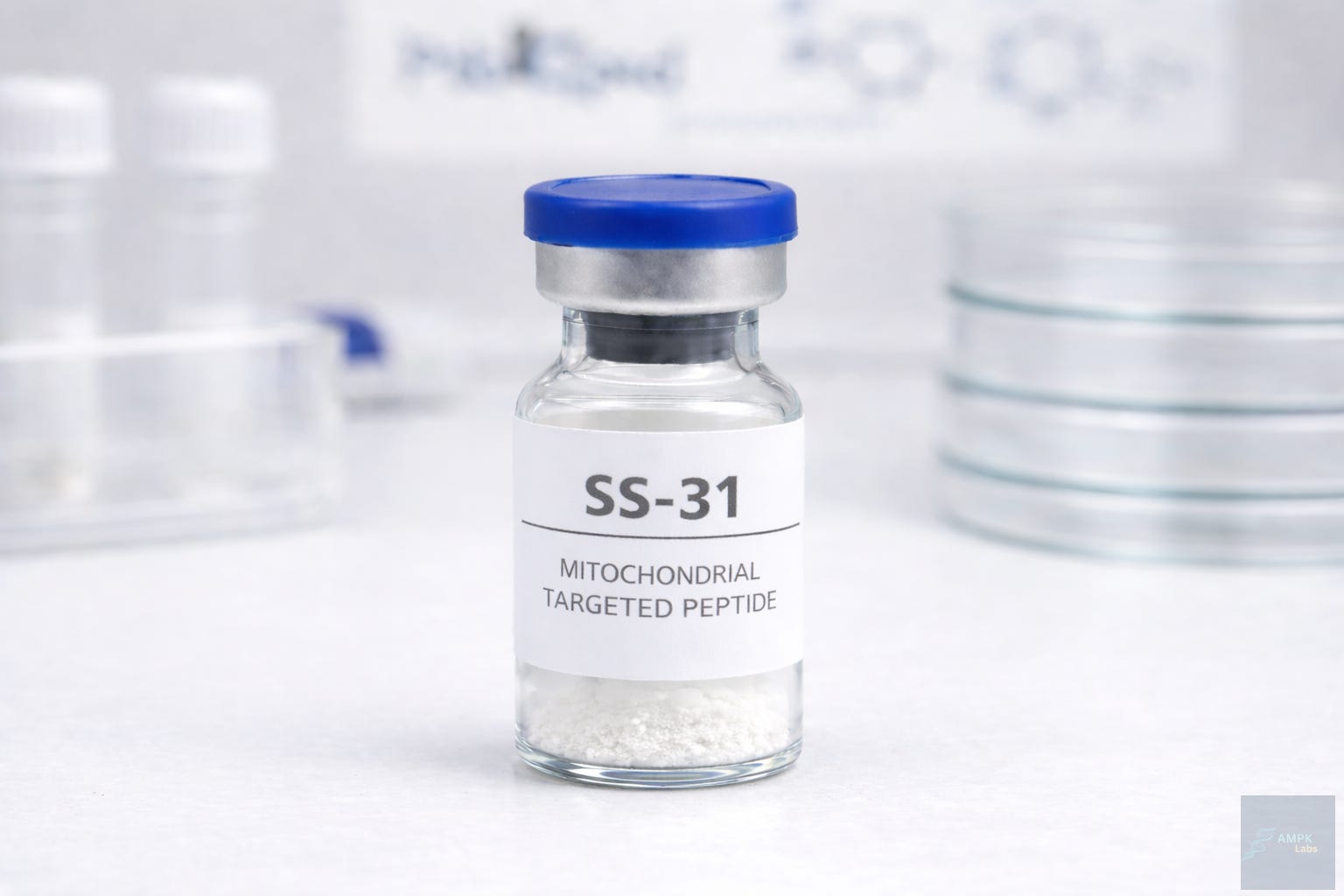
SS-31, also known as Elamipretide, is often described as a “mitochondrial antioxidant.”
SS-31 does not function as a traditional antioxidant scavenger. It is a mitochondria-targeted tetrapeptide that binds cardiolipin and stabilizes the inner mitochondrial membrane, influencing electron transport chain efficiency and reactive oxygen species signaling.
Understanding SS-31 requires separating generic redox language from structural mitochondrial biology.
This issue explains what SS-31 is, how it works, what clinical research demonstrates, and how it differs mechanistically from MOTS-c and NAD related interventions.
What Is SS-31?
SS-31 (D-Arg-dimethylTyr-Lys-Phe-NH₂) is a synthetic tetrapeptide designed to selectively target mitochondria.
It accumulates in the inner mitochondrial membrane independent of membrane potential and binds cardiolipin, a phospholipid unique to mitochondrial membranes that is essential for proper electron transport chain structure.
Unlike endocrine peptides or nuclear signaling peptides such as MOTS-c, SS-31 acts directly at the level of mitochondrial membrane architecture.
How SS-31 Works (Mechanism of Action)
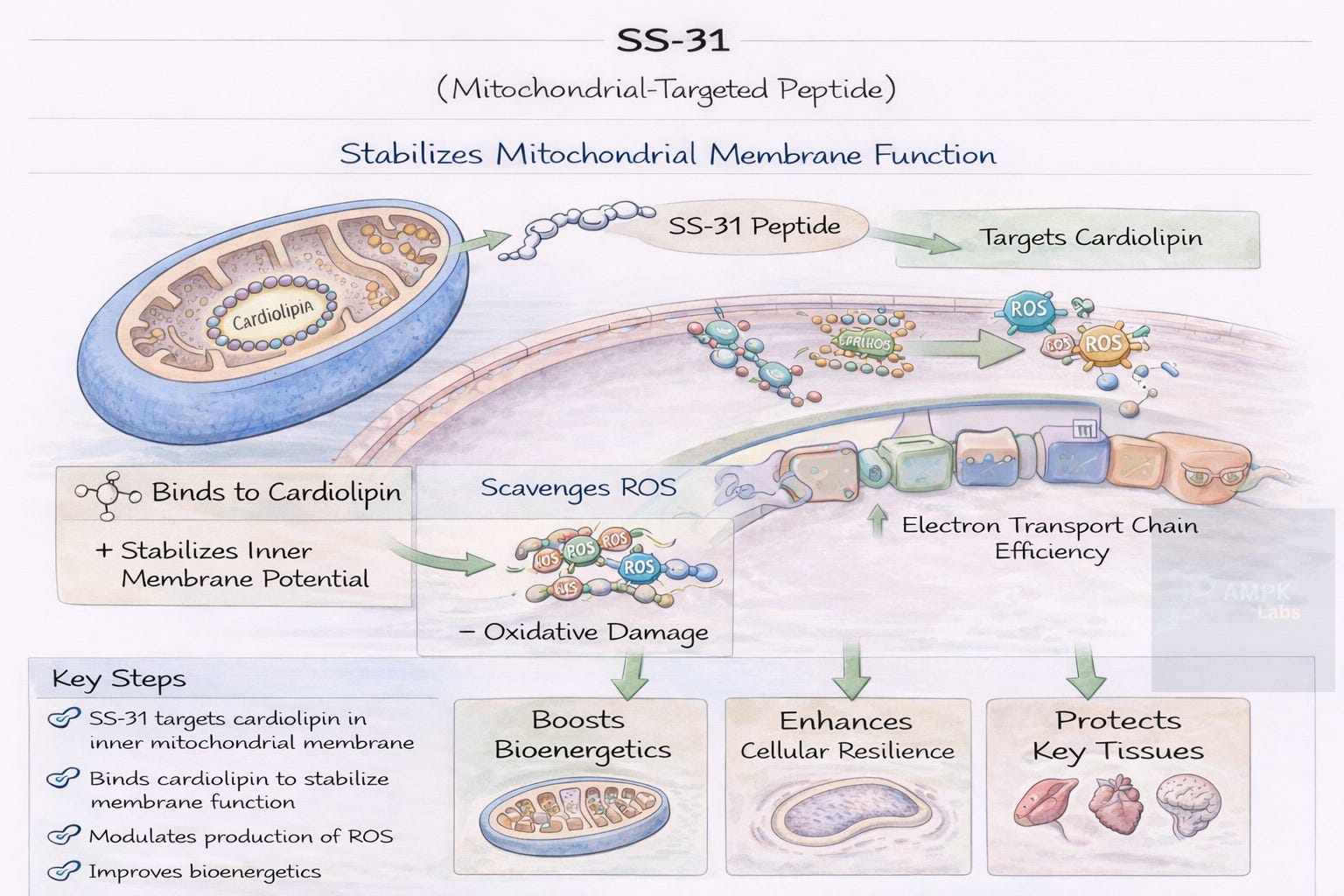
SS-31 binds cardiolipin on the inner mitochondrial membrane.
Cardiolipin plays a structural role in organizing respiratory chain complexes. When oxidized or destabilized, electron leakage increases and mitochondrial efficiency declines.
SS-31 has been shown to:
Bind selectively to cardiolipin
Stabilize respiratory supercomplex structure
Improve electron transport efficiency
Reduce excessive reactive oxygen species generation
Enhance ATP production in stressed mitochondria
Importantly, SS-31 does not act by broadly suppressing ROS. It improves bioenergetic coupling.
Its effect is structural and functional rather than hormonal or genomic.
Mechanism Diagram
SS-31 vs MOTS-c vs NAD Biology (Key Differences)
SS-31
- Targets inner mitochondrial membrane
- Binds cardiolipin
- Improves ETC efficiency
- Structural bioenergetic support
MOTS-c
- Mitochondrial derived signaling peptide
- Translocates to nucleus under stress
- Modulates AMPK and metabolic gene expression
- Regulatory signaling role
NAD biology
- Substrate level redox cofactor
- Supports sirtuins and dehydrogenases
- Influences metabolic flux and DNA repair
- SS-31 stabilizes mitochondrial structure.
- MOTS-c modulates nuclear signaling.
- NAD influences enzymatic redox capacity.
These operate at different layers of mitochondrial biology.
Common Public Claims and How They Compare to Evidence
SS-31 is just an antioxidant
What evidence supports:
Reduction in mitochondrial ROS under stress.
What evidence clarifies:
Primary action is cardiolipin binding and ETC stabilization, not generic radical scavenging.
SS-31 reverses aging
What evidence supports:
Improved mitochondrial function in disease models.
What evidence does not demonstrate:
Human lifespan extension data.
SS-31 is equivalent to NAD boosters
Mechanistically inaccurate.
SS-31 improves structural mitochondrial efficiency.
NAD replenishes substrate pools for redox reactions.
They act on different nodes of the system.
Risks and Unknowns
Areas still being clarified include:
Long term structural mitochondrial remodeling
Disease specific responsiveness
Interaction with metabolic stress and exercise
Optimal dosing strategies
Ongoing clinical development continues to refine these parameters.
Key Takeaways
SS-31 targets cardiolipin in the inner mitochondrial membrane
It stabilizes electron transport chain function
It improves bioenergetic efficiency rather than amplifying endocrine signals
It differs fundamentally from MOTS-c and NAD interventions
Its role is structural mitochondrial support
Sources
Szeto HH, Schiller PW.
Novel therapies targeting inner mitochondrial membrane from discovery to clinical development.
Pharmacological Research. 2011.
https://pubmed.ncbi.nlm.nih.gov/21163387/Birk AV, et al.
The mitochondrial targeted peptide SS-31 binds to cardiolipin and improves mitochondrial function.
Journal of Biological Chemistry. 2013.
https://pubmed.ncbi.nlm.nih.gov/23846690/Karaa A, et al.
Randomized dose escalating trial of elamipretide in adults with primary mitochondrial myopathy.
Neurology. 2018.
https://pubmed.ncbi.nlm.nih.gov/29945927/Daubert MA, et al.
Novel mitochondria targeted peptide SS-31 improves left ventricular function in patients with heart failure.
Journal of the American College of Cardiology. 2017.
https://pubmed.ncbi.nlm.nih.gov/28545606Karaa A, et al.
Randomized dose escalating trial of elamipretide in adults with primary mitochondrial myopathy.
Neurology. 2018.
https://pubmed.ncbi.nlm.nih.gov/29945927/Daubert MA, et al.
Novel mitochondria targeted peptide SS-31 improves left ventricular function in patients with heart failure.
Journal of the American College of Cardiology. 2017.
https://pubmed.ncbi.nlm.nih.gov/28545606/Szeto HH, Schiller PW.
Novel therapies targeting inner mitochondrial membrane from discovery to clinical development.
Pharmacological Research. 2011.
https://pubmed.ncbi.nlm.nih.gov/21163387/Birk AV, et al.
The mitochondrial targeted peptide SS-31 binds to cardiolipin and improves mitochondrial function.
Journal of Biological Chemistry. 2013.
https://pubmed.ncbi.nlm.nih.gov/23846690/