
Semax Explained: Nootropic Peptide, BDNF, and ACTH Fragment Biology
ACTH Fragments, BDNF Signaling, and Neuroprotection

Semax is frequently described as a “nootropic peptide” or “cognitive enhancer,” but is it?
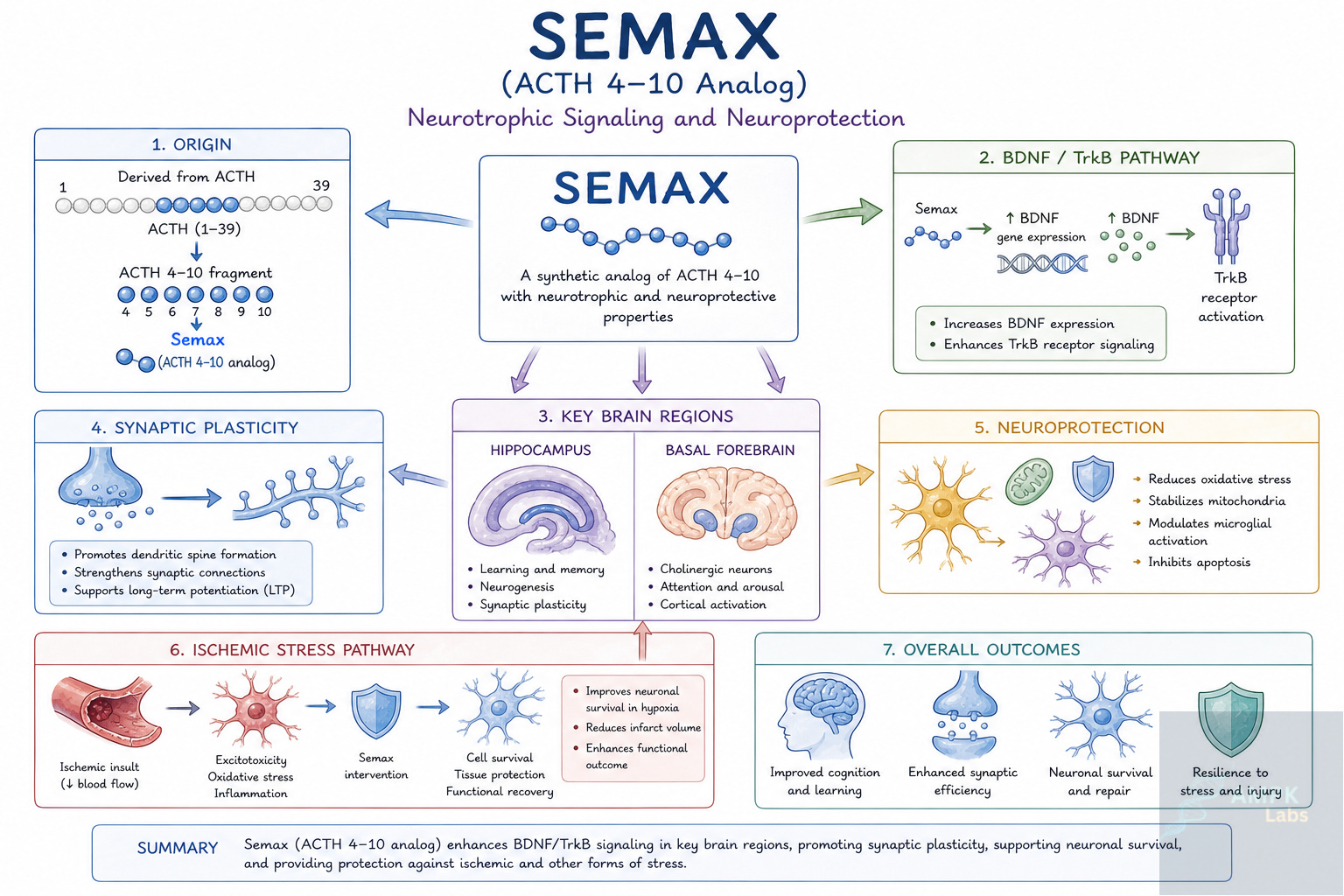
Semax is a synthetic analog of ACTH 4 to 10, a fragment of adrenocorticotropic hormone that has been modified to increase stability while preserving neuroactive properties.
Unlike Selank, which is derived from tuftsin, Semax belongs to the ACTH fragment family and is most often studied in relation to neuroprotection, BDNF signaling, ischemia models, and cognitive function.
Understanding Semax requires separating stimulant claims from neurotrophic and neuroprotective biology.
This issue explains what Semax is, how it works, how it differs from Selank and DSIP, and what the research shows.
What Is Semax?
Semax is a synthetic heptapeptide analog of ACTH 4 to 10.
Its sequence is commonly described as:
Met-Glu-His-Phe-Pro-Gly-Pro
It was designed to preserve neuroactive effects of ACTH fragments while improving metabolic stability.
Semax has been studied primarily in contexts involving:
Neuroprotection
BDNF signaling
Cognitive function
Ischemia related injury
Stress response
Unlike full ACTH, Semax is not used to stimulate adrenal cortisol production.
Its biology is centered on central nervous system signaling.
How Semax Works (Mechanism of Action)
Semax is best understood through neurotrophic and neuroprotective signaling.
1. ACTH Fragment Biology
Semax is derived from ACTH 4 to 10 rather than full ACTH.
This matters because it separates Semax from classical endocrine ACTH activity.
The peptide is intended to act more as a neuroactive fragment than an adrenal axis hormone.
2. BDNF and TrkB Signaling
Semax has been shown in rat studies to regulate BDNF and TrkB expression in the hippocampus.
BDNF is central to:
Synaptic plasticity
Neuronal survival
Learning and memory
Adaptive neural remodeling
This is one of the strongest mechanistic anchors for Semax.
3. Neuroprotection in Ischemia Models
Semax has been studied in models of cerebral ischemia.
One study found that Semax prevented enhanced nitric oxide generation in the cerebral cortex of rats with incomplete global ischemia.
This places Semax in the neuroprotection category rather than simply cognition enhancement.
4. Cognitive and Stress Pathway Effects
Semax research intersects with learning, memory, stress response, and neurotrophic adaptation.
These effects are usually framed through neuroplasticity mechanisms rather than acute stimulation.
Semax Mechanism Diagram
Semax vs Selank vs DSIP
Semax
ACTH 4 to 10 analog
BDNF and TrkB signaling
Neuroprotection and cognition
Selank
Tuftsin analog
Anxiety and neuroimmune regulation
GABAergic and enkephalin related pathways
DSIP
Sleep associated neuropeptide
Slow wave sleep and neuroendocrine rhythm
Semax sits in the neurotrophic and neuroprotection category.
What the Research Shows
Preclinical Evidence
Semax has been studied in models involving:
BDNF expression
TrkB signaling
Ischemic brain injury
Nitric oxide regulation
Learning and memory pathways
Rat studies show Semax can influence BDNF and TrkB expression in brain regions involved in plasticity and cognition.
Human Evidence
Semax has been used and studied clinically in Russia, particularly in neurological contexts.
The public conversation often focuses on nootropic use, but the more evidence aligned framing is neuroprotection and neurotrophic signaling.
Common Public Claims and How They Compare to Evidence
“Semax is a stimulant”
Semax is better understood as a neurotrophic peptide analog.
Its mechanism is not equivalent to classical stimulants.
“Semax and Selank are basically the same”
They are structurally and mechanistically different.
Selank is tuftsin derived.
Semax is ACTH fragment derived.
“Semax directly increases intelligence”
The strongest mechanistic claims involve BDNF, TrkB, neuroprotection, and plasticity related pathways.
Cognitive claims should be framed through those mechanisms.
Risks and Unknowns
Interpretation issues include:
Regional differences in clinical use
Translation from animal BDNF findings
Dose and route dependent effects
Differences between neuroprotection and cognitive enhancement
Semax should be evaluated as an ACTH fragment analog with neurotrophic signaling effects, not as a generic nootropic.
Key Takeaways
Semax is a synthetic ACTH 4 to 10 analog
It is distinct from full ACTH and does not function as a cortisol stimulant
Its strongest mechanistic anchors are BDNF, TrkB, and neuroprotection
It differs from Selank and DSIP in structure and function
It belongs in the neurotrophic peptide category
Sources
Dolotov OV, Karpenko EA, Inozemtseva LS, et al.
Semax, an analog of ACTH(4-10) with cognitive effects, regulates BDNF and trkB expression in the rat hippocampus.
Brain Research. 2006.
https://pubmed.ncbi.nlm.nih.gov/16996037/Dolotov OV, Karpenko EA, Seredenina TS, et al.
Semax, an analogue of adrenocorticotropin (4-10), binds specifically and increases levels of brain-derived neurotrophic factor protein in rat basal forebrain.
Journal of Neurochemistry. 2006.
https://pubmed.ncbi.nlm.nih.gov/16635254/Bashkatova VG, Koshelev VB, Fadyukova OE, et al.
Novel synthetic analogue of ACTH 4-10 (Semax) but not glycine prevents the enhanced nitric oxide generation in cerebral cortex of rats with incomplete global ischemia.
Brain Research. 2001.
https://pubmed.ncbi.nlm.nih.gov/11245825/